
Esports Keeps Building the Roof Before the Foundation
17 Feb 2026
Share article
We wrote this piece because the conversation around esports sustainability often focuses on funding cycles and viewership metrics while overlooking structural design. If esports is to mature inside schools, communities, and institutions, it must be built on embedded development systems—not just events. This article examines that gap.
Esports loves the top of the pyramid.
The broadcast. The stage. The finals. The prize pool. The big moment.
It looks like growth. It sells. It photographs well.
But it is not a system. It is a show.
And shores do not sustain ecosystems on their own.
If esports wants to become durable, credible, and stable inside institutions, it has to stop thinking like an event organiser and start thinking like a developer. Because right now, a lot of esports behaves like a top-heavy startup: when funding is plentiful, everything expands. When money is tight, the structure wobbles.
That volatility is not just a “market cycle.” It’s a design problem.

The pyramid is real, and the base matters more than the spotlight
Think of esports as three layers:
Top: Events, finals, broadcasts, leagues, prize pools, spectacles.
Middle: Ecosystem infrastructure Operators, venues, coaches, admins, community organisers, standards, rule sets, competition frameworks, and staffing.
Bottom: Development infrastructure, trained adults, structured progression, repeatable programs, institutional ownership, and the local environments where people learn, compete, and stick around.
Esports invests heavily at the top and expects the bottom to appear later.
It doesn’t.
And when the bottom is weak, esports becomes more sensitive to profitability because there are fewer “shock absorbers” when budgets drop.
Legacy sport did not build participation by selling finals
Football is not perfect. It’s commercial. It’s competitive. It can be ruthless.
But it got one fundamental thing right: it normalized development.
In places like the UK and the Netherlands, you don’t have to “launch” football every year. The base is always on. Local clubs. Youth environments. Coaching structures. Pathways. Identity. Repeat participation. Year after year.
The spectacle sits on top of something that already exists.
Esports often tries to do the opposite: scale the spectacle first, then hope infrastructure appears beneath it.
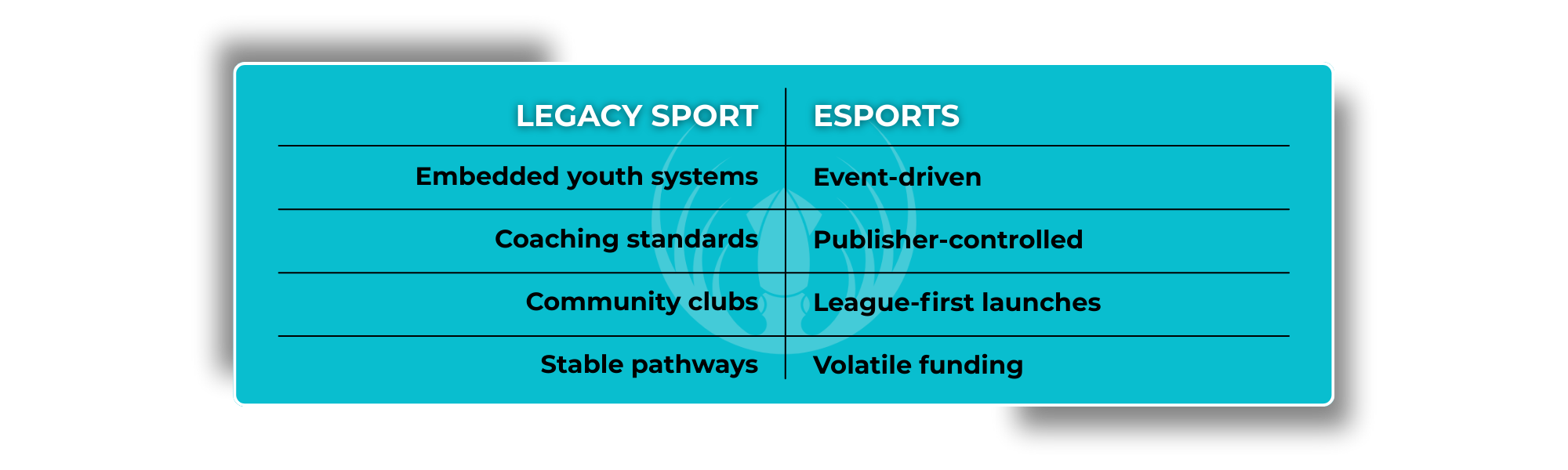
Esports grew from competition. That’s not the same as building a sustainable system.
A fair pushback is: Esports was built by events. LANs, brackets, and grassroots tournaments. That’s true.
But origin story and long-term stability are different problems.
Events can ignite interest. They don’t automatically create:
Teacher confidence
Safeguarding standards
Structured progression
Institutional ownership
Stable local participation
Inside schools and universities, you’re not building hype. You’re building something that has to survive staffing changes, exam seasons, IT audits, budget reviews, and leadership turnover.
That requires embedded systems.
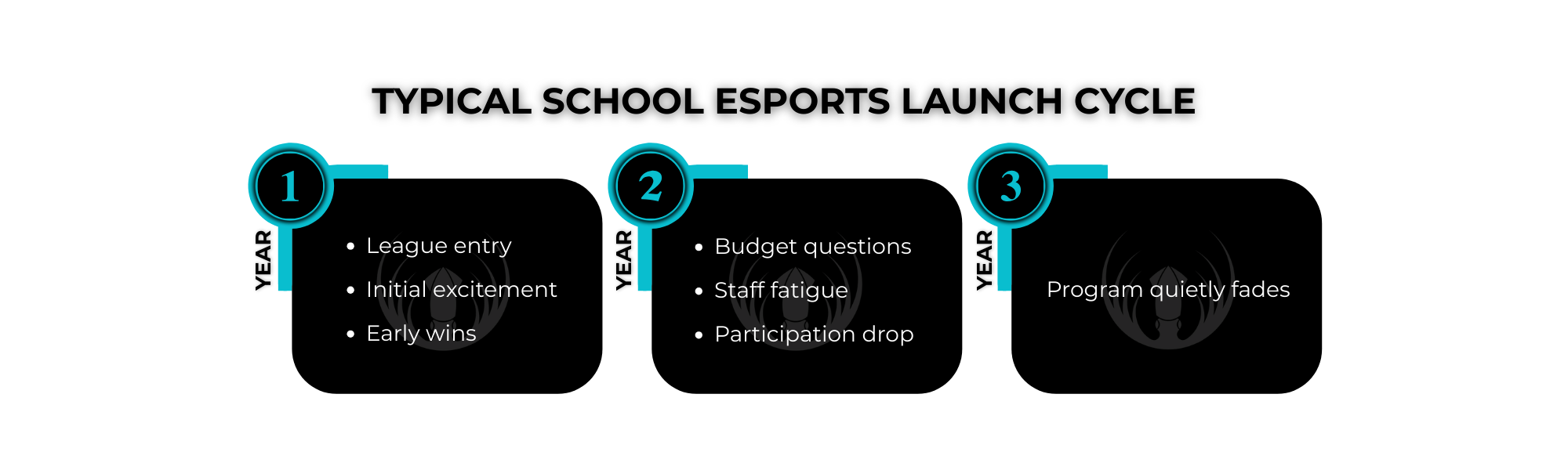
The league-first trap, now with a funding problem attached
Most school esports programs launch like this:
1. Join a league.
2. Build a team.
3. Start competing.
4. Figure out the education part later.
It feels structured because there’s a schedule and a bracket.
But competition is not development. Competition is an outcome.
When esports is built around matches instead of outcomes, you often get the same pattern:
High excitement in Year One
A small group of already-skilled players dominates participation
Minimal teacher ownership because there’s no instructional framework
Weak parent buy-in because there’s no developmental narrative
Increased behavioral and supervision pressure
Quiet decline once novelty fades
And here’s where the economics come in.
If your program’s “structure” is mostly league fees, match schedules, and event participation, it becomes vulnerable to the same budget cycles that hit the broader esports scene. When money is tight, what gets cut first is the stuff that isn’t embedded as real infrastructure.
Esports is structurally more fragile than legacy sports
Traditional sport isn’t owned by one company.
Esports titles are.
Publishers control access, updates, competitive structures, monetisation, and sometimes whether the game remains a meaningful esports at all.
Academic research has pointed directly at publisher dominance as a core difference vs traditional sport governance and economics (Frontiers, 2025).
That volatility makes development infrastructure more important, not less.
If the title changes, the developmental core should not collapse with it.
If your entire ecosystem depends on top-layer funding and publisher priorities, you are going to feel every shift in profitability.
The recent contraction in esports wasn’t just a bad season. It exposed what was missing underneath.
Esports has been openly described as contracting and "leveling down” after years of inflated expectations and investment cycles (Forbes, Dec 28, 2023).
We’ve also seen marquee league models unwind or restructure when economics didn’t hold.
The Overwatch League’s franchised model ended after teams voted to exit, and Blizzard transitioned to a new framework (Esports Insider, Nov 9, 2023)
And we’ve seen publishers explore new revenue categories as pressure rises.
Riot opened betting sponsorship opportunities for certain Tier 1 LoL and VALORANT teams, citing sustainability pressures and safeguards (Riot announcement), and it was widely reported as a financial signal of strain (The Verge coverage).
None of this is “proof that education solves esports.” That’s not the claim.
The claim is simpler and more defensible: Top-heavy esports models become fragile when funding tightens, and weak grassroots development removes the stabilisers that legacy sport relies on.
Esports 2.0 is saying the quiet part out loud
A useful parallel comes from the Esports 2.0 framework, a community-led, city-based, LAN-centered model proposed by Marcus “Esports” Howard. The framework argues that today’s scene remains structurally fragile, driven heavily by publisher control, short-lived sponsorship cycles, and top-down franchising that has struggled to deliver long-term stability.
"Esports 2.0 is intentionally designed to build a sustainable future for esports, and we are ironically going "Back To The Future", by returning to the industry's sustainable (grass)roots." - Marcus
Squid Academy has been selected as the exclusive education partner within this model, reflecting a shared belief that sustainable esports must be anchored in local development, academic integration, and structured pathways rather than relying solely on top-layer competition.

Marcus argues for rebuilding from the base: Local identity, consistent event operations, and academic partnerships.
A few lines from the framework capture the direction clearly:
“…a community-led, scalable model that places city-based esports organisations and LAN Centers at its core.”
“Partnering with schools and universities… builds future industry professionals through dedicated esports curriculum, internships, and mentorship programs.”
“The local esports community is the bedrock of this model.”
You don’t need to endorse every operational detail to take the lesson seriously: A community and education-driven base creates resilience. A top-layer-only model tracks profitability.
What real development infrastructure looks like in esports
If esports wants stable adoption inside institutions, the base must include:
Structured progression
Clear outcomes beyond rank. Communication, teamwork, leadership, media literacy, decision-making, digital citizenship, and mental performance alongside game-specific skills.
Trained adults
Not just gamers supervising a room. Educators and coaches who understand safeguarding, group management, and the practical realities of gaming culture.
Wider participation pathways
Players are one part of the ecosystem. Broadcasting, event operations, officiating, analytics, marketing, and management widen access and stabilise programs.
Safeguarding and policy alignment
Supervision structures, behavioural frameworks, data considerations, wellbeing guardrails. Things institutions require to scale.
Competition as validation, not foundation
Tournaments should reinforce what was developed, not replace development.
None of this is glamorous.
That’s exactly why it works.
If you’re launching esports in a school, start here
Before you join a league, answer:
What are the learning outcomes?
Who owns the program internally if the “esports teacher” leaves?
How are staff supported?
What roles exist beyond the starting roster?
What happens in Year Two?
For a practical breakdown of how to structure this correctly from the beginning, see our Guide to Starting an Esports Program in Your High School.
If those answers don’t exist, the program is built on enthusiasm.
Enthusiasm fades.
Infrastructure compounds.
If this resonates, we explored this issue in more depth in Edition 01 of the Esports Education Playbook: Why Most School Esports Programs Fail in Year Two. It breaks down the structural mistakes that cause promising launches to quietly stall.
Several industry leaders point to structural design, not market mood, as the real differentiator.
“School esports only succeeds when leadership genuinely backs it and knowledgeable teachers are in place. If it’s half-hearted or poorly led, students see through it quickly and the program loses credibility.” - Nik Turner, Owner, Ntesports | Head of Esports & Education Strategy, Yoyotech | Advisor, Squid Academy
“The biggest structural difference is IP ownership. Traditional sports don’t belong to a single commercial entity, even if governing bodies operate them. Esports titles do. Because games are owned IP, publishers ultimately control how the ecosystem operates, which limits how freely organisers and stakeholders can build around them.
In traditional sport, that limitation doesn’t exist and that difference has huge implications for long-term stability.” - Philip Hübner, Chief Commercial Officer, Wehype | Former Chief Business Development Officer, Challengermode | Advisor & Instructor, Squid Academy
"Consistent local play promotes a competitive community atmosphere in a safe/predictable environment that supports local player growth, and camaraderie between players." - Luis Ballester, COO, Damascus Gaming (Squid Academy's Exclusive Texas Partner)
The shift esports has to make
Esports is not short on talent or passion.
It is short on stable structural base that lives below the spotlight and survives budget cycles.
Events will always matter.
But the future of esports won’t be decided by the next stage.
It will be decided by whether schools and communities can run structured programs that still function three to five years after launch.
That requires development at the base.
Without it, everything above remains temporary.
Related articles
19 Aug 2024
Guide to Starting an Esports Program in Your High School

19 Aug 2024
The Importance of Positive Mental Health in Esports

19 Aug 2024